



The same corrosive fluid can behave differently as its concentration, temperature, pressure, velocity, dissolved gases or contamination change. This means that a material that performs well in one acid stream may be unsuitable in another, and a mixer that survives the fluid still has to support the required mixing performance, cleanability and mechanical duty. The solution is not usually as simple as naming a stronger material and moving on.

In this article, we look at how static mixer materials of construction should be considered in corrosive applications, from PTFE-lined designs to alloy selection and sanitary process constraints.
How To Define A ‘Corrosion Resistant’ Static Mixer
In industrial applications, “corrosive” can describe very different mechanisms. A low-pH stream may create general metal loss across exposed surfaces, while chloride-containing fluids can drive localised pitting or crevice corrosion. Oxidising and reducing acids can also behave differently with the same alloy family. In process lines that handle cleaning chemicals, by-products or variable feed streams, the mixer may experience short exposure peaks that are more severe than the normal operating condition.
That is why your material choice has to follow the actual duty. Fluid chemistry, concentration, temperature, solids content, and operating pressure strongly influence the construction that can be used safely. The mixer elements, housing, injection connections and any sample points also all need compatible wetted materials, because corrosion will not politely confine itself to the most obvious component.
PTFE-Lined Static Mixers
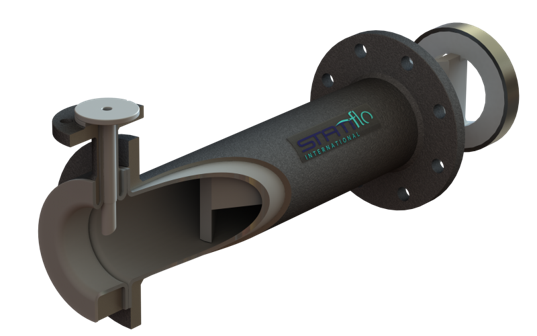
PTFE (polytetrafluoroethylene), a fluoropolymer best known by the trade name Teflon, is often specified for mixing applications where metallic wetted parts are likely to face aggressive chemical attack. The Series 300 corrosion resistant static mixer from Statiflo, for example, uses pure PTFE removable mixing elements with a PTFE-lined housing for corrosive duties, with PTFE/PFA injection or sample tees available where required. The design is intended for applications where the corrosion resistance of the lining and elements is central to keeping the mixer in service.
Because the lining is the corrosion barrier, testing becomes a core part of the material decision process rather than a separate quality step. Spark integrity testing is used to detect flaws in the PTFE lining, while hydrotesting checks the pressure-containing assembly. In a corrosive duty, those checks are directly linked to service suitability because any defect in the lining could expose the housing material to the process fluid.
Metallic Alloys And Mechanical Duty
However, not every corrosive application calls for a lined mixer. 316 stainless steel, duplex and super duplex stainless steels, Alloy C276, Inconel, titanium and other commercially available materials can all be appropriate where the fluid, pressure, temperature and mechanical duty point toward metallic construction.
A high-temperature process, abrasive slurry, chlorinated cleaning regime or thermal cycling can all affect the material route. Nickel-chromium-molybdenum alloys such as Alloy C276 are often considered for demanding chemical environments, while titanium may be relevant where its corrosion behaviour suits the specific fluid. Corrosion resistance has to be considered alongside pressure rating, temperature, fabrication route and inspection requirements for the complete mixer assembly.
Polymer Options Have Operating Limits
Polymer constructions can be valuable in aggressive chemical duties, but it's worth noting that each polymer has its own operating envelope. PP, PVDF (polyvinylidene fluoride) and other engineered plastics differ in chemical resistance, temperature limits, pressure constraints and mechanical behaviour. The material route needs to account for the complete duty cycle: fluid chemistry, temperature, pressure, solids content, velocity and injection arrangements. In applications involving abrasive particles, pressure cycling or local mechanical stress around injection points, those operating conditions become part of the material decision alongside chemical compatibility. A compatibility chart can identify candidate materials, but the final choice depends on the full duty inside the line.
Find Out More
To learn more about corrosion resistant static mixer applications and how Statiflo can support your process, contact our team to discuss your operating conditions, material requirements and performance objectives. We can advise on suitable mixer designs, corrosion-resistant alloys and configurations tailored to demanding environments. Click here to get in touch and start the conversation.

