



In a direct steam injection system, the critical event happens at the point where steam enters the liquid. The steam has to disperse, condense and release heat inside the moving stream, without leaving local hot areas or unstable outlet temperature. That makes the injection area central to the design.

A static mixer is used here because it controls how steam, condensate and liquid are brought together inside the pipe. In this article, we take a closer look at how static mixers are used in steam heating and direct steam injection (DSI) applications across a range of industries.
DSI Is A Phase-Change Mixing Duty
A static mixer in a DSI system manages both flow and heat transfer. Steam enters as a vapour, gives up latent heat as it condenses, and becomes part of the liquid stream. Meanwhile, the mixer elements keep the liquid moving across the injection area so the steam is dispersed through the flow while condensation takes place.
Poor steam distribution can show up as temperature instability, noise, vibration or inconsistent heating. In heat-sensitive processes, local thermal variation can affect viscosity, material condition, reaction behaviour or downstream control. The mixer specification therefore has to account for steam pressure, liquid flowrate, inlet temperature, target outlet temperature and acceptable pressure loss in the same design exercise.
Radial Steam Introduction Controls The Injection Area
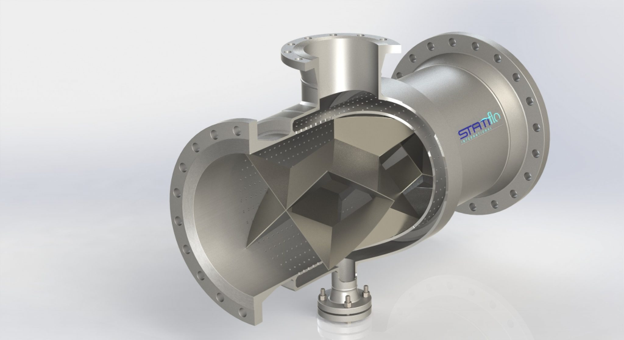
So, how is this operational challenge resolved in practice? As an example of a static mixer design with an established use history, the Statiflo Series 800/850 steam heater uses radial steam introduction. The mixer housing is drilled with steam injection holes around the mixer zone, allowing steam to enter the liquid from multiple points rather than from one concentrated jet. The Series 800 uses fixed STL elements, while the Series 850 uses fixed STM elements, and the element geometry can be adjusted around maximum headloss or installed-length requirements.
This configuration supports rapid steam dispersion through the liquid as condensation takes place, making the mixer the part of the system that determines how evenly the steam is introduced and how quickly the heated stream becomes thermally consistent.
The Process Must Accept The Condensate
Direct steam injection is suitable where the process can accept condensate from the injected steam. A jacketed vessel or shell-and-tube heat exchanger keeps steam and process fluid separate by transferring heat through a wall. DSI removes that heat-transfer barrier, creating a compact and responsive heating method, with the added condensate becoming part of the process stream. That difference shapes your static mixer specification. In many applications, the discussion may also include steam quality, dilution, cleanability and process condition requirements.
Material And Documentation Requirements Follow The Duty
Steam temperature, pressure containment, corrosion behaviour and project documentation can influence the mixer construction as much as the heating target. To accommodate this, the Series 800/850 units can be supplied in a range of materials including stainless steel, Alloy C276, duplex and super duplex stainless steels, Inconels and other commercially available materials. Applicable design codes can include ASME B31.3, ASME VIII Div 1, AD2000 Merkblatt and PED 2014/68/EU, depending on project requirements.
What To Define Before Specification
A direct steam injection static mixer specification should include liquid properties, liquid flowrate, inlet temperature, required outlet temperature, steam pressure, steam quality, operating pressure, allowable pressure loss, pipework constraints, material requirements and any QA or documentation needs. If the process has tight temperature tolerance or is sensitive to dilution, shear, residence time or local overheating, those conditions should be stated at the beginning.
With that information in place, the mixer can be implemented as a controlled in-line heating component, with steam distribution, condensation, pressure loss and outlet temperature treated as connected design conditions.
Speak To Our Team
Please contact our team with details of your steam pressure, liquid flow rate, inlet and target outlet temperatures, and any system constraints such as allowable pressure loss or installation limits. We will review your requirements and provide a tailored static mixer specification, including recommended design configuration, materials of construction and expected performance. Our engineers can also support integration into existing pipework, ensuring reliable operation, consistent temperature control and efficient steam utilisation across your process.

