



Introduction: Static Mixers For Use In The Hydrocarbon Sector
Revolutionising fluid dynamics for greater efficiency, compliance, and innovation in oil, gas, and petrochemical processes.
Achieving precision, efficiency, and compliance in oil, gas, and petrochemical industries demands advanced engineering solutions. Static mixers have emerged as vital tools in this regard, delivering unparalleled performance for blending, refining, and enhancing product quality in various hydrocarbon processes.

In this guide from Statiflo, we provide a comprehensive overview of static mixers, their applications within hydrocarbon industries, and how our products can help you strengthen quality, consistency, efficiency and compliance across your processes.
What Is A Static Mixer?
A static mixer is an inline device engineered to blend fluids, liquid, gas, or a combination without needing moving parts or an external power source. Using strategically designed internal elements, it achieves homogeneous mixing by dividing and redirecting fluid flows, creating controlled turbulence that facilitates blending. Known for simplicity, durability, and efficiency, static mixers are designed for low-maintenance and replicable consistency.
How Do Static Mixers Work?
Static mixers operate by harnessing several core principles of fluid dynamics, primarily flow splitting and recombination, radial mixing, and vortex generation to deliver a thorough and consistent blend. Each stage in the mixing process maximises contact between the fluid components and promotes homogeneity, ensuring process integrity in demanding industrial environments. Let’s take a closer look at each process:
- Flow splitting: as process fluid enters the static mixer, it encounters a sequence of fixed internal elements or baffles precisely arranged to partition then recombine the flow repeatedly. For example, in crude oil blending within a pipeline, these elements split the incoming stream into multiple sub-streams. As it encounters each subsequent element, the number of streams increases exponentially, rapidly enhancing the total contact surface area between different fluid components or additives. This technique is particularly effective for rapid additive distribution or multi-grade oil homogenisation.
- Radial mixing: following the initial splitting, the mixer’s elements are often contoured or twisted to force the sub-streams from the pipe’s centre towards the walls and vice versa. This redirection promotes mixing across the entire pipe cross-section, reducing the risk of incompletely blended zones emerging. In hydrocarbon processing, radial mixing is vital for ensuring the even dispersal of corrosion inhibitors or demulsifiers, where incomplete distribution could otherwise result in equipment fouling or an off-spec product.
- Vortex flow: the combination of angled mixing elements, sudden changes in direction, and obstruction-induced turbulence introduces local vortices within the fluid. These controlled vortices further agitate the constituent streams, promoting molecular-scale mixing. In downstream applications like custody transfer sampling (see below), this vortex formation ensures that the sampled product accurately represents the bulk flow, which is critical for compliance and transactional integrity.
Where Does The Power Come From?
The entire mixing process is powered solely by the kinetic energy of the flowing fluid, meaning that no external motors, pumps, or ancillary drive systems are required. As a result, static mixers deliver significant advantages in energy efficiency and operational simplicity. The absence of moving parts also translates to negligible mechanical wear, reducing both the frequency of maintenance and the risk of process interruptions.
This is especially beneficial in environments where process uptime is crucial and maintenance shutdowns are costly, such as offshore platforms or continuous refinery operations. Over time, the reduced energy consumption and minimal maintenance burden contribute to a lower total cost of ownership and enhanced operational reliability, both of which are prioritised in the hydrocarbon sector.
Why Static Mixers Matter In Hydrocarbon Industries
Hydrocarbon industries operate under immense pressure to maintain consistent product quality, ensure compliance with stringent regulations, and to optimise processes in confined or challenging environments. Static mixers excel in these demanding conditions due to their reliability and adaptability, as illustrated by their key applications in the petrochemical processing sector.
Applications: How Static Mixers Support The Hydrocarbon Industry
1. Custody Transfer Sampling
Custody transfer sampling is another vital application where static mixers play a pivotal role. Custody transfer involves the commercial exchange of hydrocarbons, where flow measurement precision is critical to ensure fair value transactions. Even minor inaccuracies in metering and sampling can result in significant financial discrepancies. Thus, achieving product homogeneity before sampling is non-negotiable, with standards like ISO 3171 and API Chapter 8.2 governing best practices.
During the commercial transfer of raw or refined hydrocarbons between entities, obtaining a truly representative sample of the flow is essential for fair billing and contractual integrity. The static mixer’s ability to generate a homogeneous mixture immediately before the sampling point ensures that the collected sample accurately reflects the bulk properties of the entire shipment or batch. This reduces sampling bias, upholds traceability, increases repeatability and is essential for meeting industry standards.
2) Refining And Blending
In the context of refining and blending, static mixers support the critical process of homogenising different hydrocarbon streams. Blending crude oils and natural gases of varying grades or properties is frequently required to meet strict product specifications, manage supply variability, and enhance overall refinery output. The advanced mixing technology within static mixers ensures the complete and continuous integration of all components, eliminating inconsistencies or layering. This guarantees that the resulting blend meets your quality standards and regulatory framework, even under high flow rates and varying operational conditions.
3. Additive injection
One of the primary applications of static mixers in hydrocarbon processing is additive injection. The introduction of corrosion inhibitors, demulsifiers, and other treatment chemicals into oil and gas streams requires highly accurate and uniform blending to achieve the optimal effects. Static mixers are engineered to rapidly and thoroughly disperse these additives across the entire cross-section of the pipeline, ensuring effective treatment, improved operational performance, and reduced chemical wastage. This is particularly important for downstream integrity, as inadequate dispersion can lead to under-treated zones, sub-optimal process outcomes, and accelerated equipment degradation.
4. Breaking and forming emulsions
Finally, the control of breaking and forming emulsions can be a significant challenge in upstream and downstream hydrocarbon processing. Emulsions such as water-in-oil or oil-in-water mixtures often require either thorough breakdown (for example, ahead of water removal) or a stable formation for specific processing steps. Static mixers deliver the high shear forces and turbulent conditions necessary for efficient and energy-efficient emulsion management. By precisely controlling residence time and mixing intensity, operators can optimise phase dispersion or separation in a manner that is both energy-efficient and adaptable to various process conditions.
Our Product Range For Hydrocarbon Businesses
To address the diverse operational and process demands of the hydrocarbon sector, Statiflo provides a comprehensive range of static mixer series. Each series has been precisely engineered for specific applications common in oil, gas, and petrochemical processing, delivering optimal results in terms of mixing efficiency, reliability, and compliance.
Series 100/150 – General Pipeline Mixing
The Series 100 and 150 static mixers are designed for universal inline mixing tasks encountered throughout hydrocarbon processing pipelines. Typical applications include the blending of process fluids, homogenisation of multiple crude qualities, and the injection and dispersion of chemical additives (such as corrosion inhibitors, scale inhibitors, demulsifiers, and neutralisers). The mixers are available in high-grade stainless steel, duplex, or carbon steel to ensure compatibility with aggressive and sour service environments. Their design reduces downtime for cleaning, inspection, and maintenance—advantages critical for facilities operating under tight turnaround schedules. The robust construction also supports high-throughput operations and extended service life, providing reliability for both new installations and retrofits.
Series 150CT – Custody Transfer & Precision Sampling
Our Statiflo Series 150CT mixers are engineered for custody transfer points, where product uniformity and representative sampling are essential for commercial transactions and regulatory compliance. The mixer incorporates dual-leading-edge STM-CT elements, which are optimised to exceed the industry-standard C₁/C₂ ratio (≥ 0.9) as required by ISO 3171 and API Chapter 8.2. This guarantees a homogeneous mixture, allowing sampling and metering systems to provide accurate and repeatable readings. Fully welded construction provides mechanical integrity under varying pressure and flow conditions, while available options such as integrated sample ports and water injection connections provide flexibility for operation and maintenance. The Series 150CT is manufactured to ASME, ISO, API, and EN standards which are critical for compliance in downstream custody transfer, blending terminals, and cross-border pipeline operations and is supported by full documentation for audit and traceability purposes.
Series 300, 700 and 800/850 – Specialist Applications
The Series 300, 700, and 800/850 static mixers are engineered for the most specialised and demanding hydrocarbon processing applications. These models deliver superior solutions for blending high-viscosity fluids, preparing emulsions, and processing slurries—tasks common in oil refining, lubricant production, and polymer blending. With corrosion-resistant PTFE linings (Series 300), high-efficiency designs for viscous media (Series 700), and integrated direct steam injection for rapid heating (Series 800/850), each mixer is available in a range of materials and can be fully customised in length and element geometry. Statiflo’s modular approach ensures precise adaptation to your specific process requirements, supporting both pipeline and large-volume tank mixing for even the most challenging hydrocarbon industry scenarios.
Gas Dispersion Systems – Enhanced Gas-Liquid Interactions
Our Statiflo gas dispersion systems are engineered to maximise the mass transfer efficiency in gas-liquid processes fundamental to the hydrocarbon industry, such as gas sweetening, amine treatment, VOC scrubbing, and oxygenation/stripping applications. By optimally dispersing gases through the liquid phase, our mixers ensure uniform reaction conditions, minimise channelling, and promote full process consistency. Advanced element designs minimise energy consumption and reduce the risk of fouling, supporting continuous operation in demanding process environments.
How We Choose The Right Static Mixer For Your Application
Choosing the right static mixer demands a thorough understanding of a range of operational parameters and system constraints. Our mixer series empower industry professionals to address these challenges with rigour, with tailored solutions that account for the practical field realities and technical requirements encountered in hydrocarbon processing plants. Parameters to consider include:
Flow Rate And Reynolds Number:
The volumetric flow rate and corresponding Reynolds number dictate the nature of mixing, whether the flow regime is laminar, transitional, or turbulent has a direct impact on element selection and the overall mixer configuration. For example, in batch blending applications or pipelines where laminar flow prevails due to high product viscosity or low velocities (such as certain crude or fuel oil transfer lines), static mixer elements are configured to maximise flow splitting and recombination while minimising pressure drop. Conversely, when blending lighter, lower-viscosity streams at higher velocities (e.g., during petrol additive injection or natural gas odourisation), turbulent flow can be harnessed to promote rapid homogenisation with minimal residence time.
Pressure Drop Constraints:
Pressure drop across the mixer is a critical design factor in hydrocarbon operations due to its direct effect on energy consumption and system performance. Excessive pressure drop can increase pump loads or limit throughput, which is particularly problematic in long pipeline runs or retrofitted systems with limited hydraulic headroom. Our engineers work to optimise mixer geometry to the requirements of the intended application, balancing mixing efficiency with acceptable pressure loss. For instance, during custody transfer metering, strict pressure drop limits may be in place to maintain calibration integrity and process control. In such scenarios, element spacing and shape are customised to meet performance targets while conforming to operational thresholds.
Pipe Diameter And Length:
The static mixer must be precisely dimensioned to fit your existing pipeline or process header. The internal element length and the number of mixing stages are, therefore, determined with respect to the pipe diameter and the specific blending duty.In confined offshore environments where space is at a premium, we can supply high-efficiency element profiles that achieve your desired mixing outcome within a constrained installation footprint, facilitating ease of integration without compromising your process outcomes.
Material Compatibility:
Hydrocarbon environments often subject process equipment to aggressive chemical substances, high temperatures, and, in many cases, austere service conditions containing hydrogen sulphide (H₂S) or chlorides. Material selection, therefore, is critical to ensure the durability of your assets and regulatory compliance. At Statiflo, our static mixers are manufactured from a range of durable alloys, including 316L stainless steel, duplex and superduplex steels, and corrosion-resistant carbon grades, selected to meet project-specific requirements such as NACE MR0175/ISO 15156 for sour service. For example, mixers utilised in refinery desalter streams require robust corrosion resistance and weld compatibility to minimise risk of failure and unplanned outages. We can supply the appropriate material composition for your mixer so that it withstands the rigours of your application, while minimising your lifetime cost of ownership and repair needs.
Modularity And Custom Engineering:
Process facilities often require customised solutions due to unique combinations of flow conditions, spatial constraints, and integration challenges. Our team specialise in modular static mixer designs that can be tailored to application-specific requirements during both new builds and retrofit projects. Mixers are supplied with robust mixing elements for maintenance-critical lines, flanged or welded connections depending on process safety demands, and optional features such as injection or sampling ports. For example, where clients seek to blend multiple product streams into a single header or accommodate phased expansion, we can create versatile static mixers that accommodate future adaptation and scalability, reducing your total lifecycle costs and maximising operational versatility.
By meticulously addressing these factors and calibrating each mixer to address your operational challenges, we help you increase the long-term resilience of your operation under the varied and demanding conditions of the hydrocarbon industry.
Quality Assurance And Documentation
Statiflo’s commitment to stringent quality assurance is critical for ensuring reliability, safety, and compliance in hydrocarbon processing environments where regulatory oversight and operational integrity are paramount. We provide everything you need to demonstrate quality assurance, legal compliance, and customer satisfaction in your mixing operations, for example:
Comprehensive Documentation Suite: We provide a full range of documentation for each project and product, including ISO 3.1 or 3.2 material certifications, non-destructive testing (NDT) reports, welding procedure specifications (WPS/PQR), inspection and test plans (ITPs), and detailed traceability records. This documentation ensures that every static mixer can be traced back through its manufacturing process, material origin, and quality checks, facilitating both internal audits and third-party verification.
Regulatory Compliance and Standardisation: Adherence to global industry standards is integral to our design and manufacturing approach here at Statiflo. All relevant products are manufactured and tested in compliance with ASME, API, ISO, and EN guidelines, ensuring compatibility with international codes required in the hydrocarbon sector. This standardisation supports project certification, regulatory approval processes, and smooth integration with existing infrastructure.
Engineering Expertise and Custom Design Validation: Our engineering team collaborates closely with clients to conduct bespoke and detailed reviews of the operational conditions , providing solutions tailored to the unique challenges of each application. Advanced design validation and CAD modelling underpins every project, ensuring robust performance before deployment. This technical support not only expedites the project lifecycle but also provides assurance that mixers are optimised for both operational requirements and regulatory obligations.
Value to Clients and Operational Reliability: By combining extensive documentation, strict compliance, and proactive engineering support, we provide a solution that is pre-verified for reliability and regulatory adherence. This reduces project risk, supports your ongoing maintenance and inspection regimes, and provides confidence in meeting both production and legal standards in demanding hydrocarbon industry environments.
Case Studies: How Our Products Have Supported Customers In The Petrochemical And Hydrocarbon Industries
See below for four real world examples of how our static mixers have facilitated various hydrocarbon processing functions. To find out more about these projects or to discuss how we can help improve your application, please contact our team directly.
1. Hydrogen sulphide contamination of crude oil
PROBLEM
Hydrogen sulphide contamination of crude oil threatened closure to a well head on a well known North Sea oil platform owing to resultant H2S gas handling constraints and corrosion of valuable plant. These conditions called for the introduction of an H2S scavenging agent right at the well head to de-sour the crude oil before contact with any further plant.
A mixer was required which could:
• operate completely effectively to ensure neither the scavenging agent nor the hydrogen sulphide
remained resident beyond the flowline
• operate at a very high pressure (c. 350 bar)
• be corrosion resistant itself
• be very space efficient
Total quality assurance was paramount owing to the very high value of the installation and time was vital every day meant lost production.
SOLUTION
The customer’s engineers selected Statiflo to solve the problem. Statiflo engineers developed a static mixer using an extra strong corrosion resistant alloy Hastelloy C276 in a tailor made configuration designed to allow a three element mixer to be integrated into a long radius bend situated directly on top of the production well head. Additionally- specialist high pressure quick release end connections were incorporated to conform to oil industry standards.
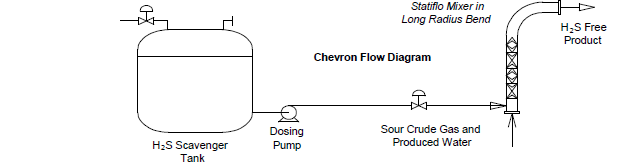
The design fully met the customers exacting requirements and has been operating to the full satisfaction of the customer's engineers for over 25 years.
Hydrogen Sulphide Contamination of Crude Oil
RESULT
Without the successful introduction of HS2 scavenging with the use of the inline mixer- this well head could not have operated since millions of pounds worth of downstream processing and associated gas equipment might have been damaged by the corrosive crude oil and gas. The static mixer allowed the corrosive scavenger to contact the HS2 rapidly and thus prevent either chemical or HS2 to exit the flowline. With the use of Statiflo’s Motionless Mixer technology a valuable revenue stream has now been reinstated.
STATIFLO MOTIONLESS MIXER FEATURES OF PRIMARY IMPORTANCE IN THIS CASE STUDY
• No moving parts for virtually maintenance-free operation
• Minimal space requirement
• Manufactured to meet all levels of QA/QC
• Custom designs to meet custom specifications
• Chemical injection rates reduced to a minimum
• Manufactured in all commercially available materials
• Low installed weight
• Can be installed in bends to save space
OTHER STATIFLO FEATURES
Low energy consumption
• Low capital cost
• Completely sealed system
• Predictable blending and dispersion formation
• Eliminates radial gradients
• Approaches ideal plug flow
• Improved process control ' product quality
• Self cleaning
• Processes all pumpable material in laminar or turbulent flow
• Eliminates overdosing
• Available in small and large diameters
• Designs available for open channel and rectangular duct systems
2) Improved tank blending – Lube oil blending plant
PROBLEM
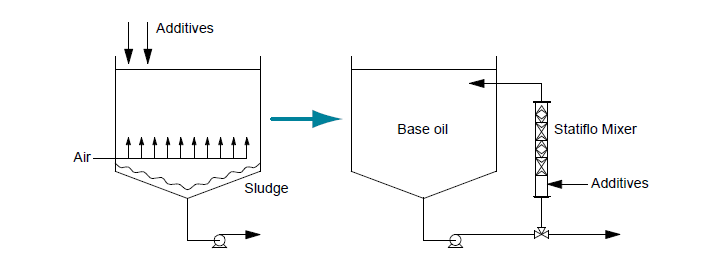
A lube oil blending plant in the north west of England was experiencing a whole host of problems with its existing tank mixing system, ranging from excessive energy consumption to poor product quality control. The company was using large 1500 tonne tanks, approximately 10m diameter x 10m high, to blend various proprietary additives into base oil in the manufacture of engine oils. Preweighed amounts of additive were manually dumped into the top of the tank and mixed by compressed air from a sparge system above the tank floor. This arrangement had many drawbacks:
• Long mixing time – 4 to 5 days
• High energy consumption—compressed air is expensive—and starving of other plant where air was
essential
• Oxidation of base oil
• Overdosing of expensive additives due to poor mixing
• Frequent tank cleaning and sludge removal due to overdosing
SOLUTION
Statiflo recommended that the dedicated transfer pump should be used to provide the energy for mixing using a Statiflo Motionless Mixer installed in a recycle line. Additives should be injected at the Mixer for optimum effect.
Improved Tank Blending
RESULT
Batch mixing times were reduced from several days to approximately 16 hours. Compressed air was no longer required for mixing and oxidation of the base oil eliminated. The air sparge system was removed from the tank, and equipment elsewhere on the plant was no longer starved of compressed air. The sludge buildup was stopped because of improved mixing and lack of overdosing. This was also helped by pumping the recycle stream from the tank bottom.
Following its immediate success, a further nine tanks were converted and each provided with a dedicated Statiflo Motionless Mixer.
FEATURES OF PRIMARY IMPORTANCE IN THIS CASE HISTORY
• Efficient- rapid mixing
• Low energy consumption
• No moving parts for maintenance free operation
• Reduced additives consumption and eliminated wastage
• No product deterioration
• ‘On spec’ product
3) Gas/gas turbulent mixing – Gas mixing station
PROBLEM
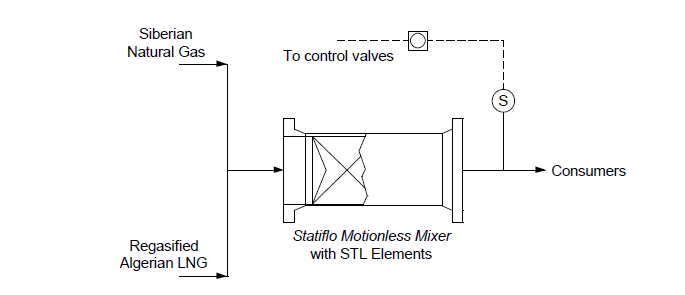
Mixing of two different types of natural gas in a large diameter pipeline is not straightforward despite the high velocity- high turbulence and low viscosities. Relying on natural turbulence in a long pipe for mixing results in unrepresentative sampling and long time lags in the control system. Good and fast mixing are essential for continuously monitoring and controlling the Net Heating Value of the gas mixture.
SOLUTION
Two Statiflo Motionless Mixers were chosen for installation at a Gas Mixing Station on a major gas transmission system. The parallel lines were 900mm diameter, operating at 32 bar g for mixing natural gas with regasified LNG. The Mixers were designed for use in a high velocity, highly turbulent service.
Careful attention to mixing is crucial in situations where even the smallest deviation from good mixing could result in substantial loss of revenue.
RESULT
Athens area consumers now rely on Statiflo Motionless Mixer technology for the continuous monitoring and control of Net Heating Value of natural gas to their city. The equipment is simple, safe, reliable, without moving parts, requiring no maintenance and is ideally suited for a hazardous duty.
FEATURES OF PRIMARY IMPORTANCE IN THIS CASE HISTORY
• Safe and reliable
• Low installed cost
• No moving parts for maintenance free operation
• Consistent and predictable performance
• Allows representative sampling for optimum process control
• Sampling at Mixer discharge for fast response time of control system
• Completely sealed system
4) Gas/liquid turbulent mixing – Heavy oil upgrading project
PROBLEM
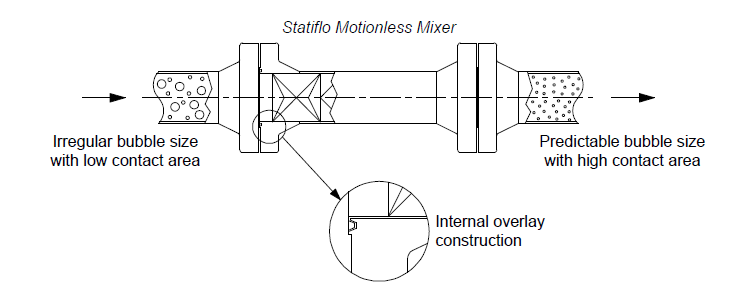
A Japanese contractor, working on a heavy oil upgrading project in Korea, required a cost effective method of intimately contacting a two phase gas/ liquid system. Expensive large diameter towers with complex internal packing were considered to be unsuitable because of the very corrosive nature of the fluids and the high operating pressures. Contacting would have to be equally effective under two operating conditions; normal operation and regeneration operation.
SOLUTION
Statiflo was approached to design an inline Motionless Mixer with diameter identical to the connecting 26” pipe, suitable for operation at 175 kg/cm²G & full vacuum at 165°C. High pressure flanges were required with internal mixing elements specified in Incoloy 800. Mixer housing was to have Incoloy 800 overlay on carbon steel.
Due to the high operating pressure and very corrosive service, rigorous quality control and testing were essential.
RESULT
The close to ideal plug flow characteristic and intense radial mixing in the Statiflo Motionless Mixer resulted in a predictable and narrow droplet size distribution of liquid in gas. Contacting was optimised in a relatively low cost inline design in corrosion resistant construction. Energy consumption, in terms of pressure drop, was extremely low and well within the capabilities of the existing pumping systems.
Gas/Liquid Turbulent Mixing
FEATURES OF PRIMARY IMPORTANCE IN THIS CASE HISTORY
• Low installed cost
• No moving parts for maintenance free operation
• Consistent and predictable performance
• Approaches ideal plug flow
• High area of contact between phases
• High QA /QC manufacturing standards
• Corrosion resistant, high pressure design
• Low pressure drop
Find Out More
By continuously driving innovation within our product range in line with emerging trends, technologies, and customer needs, Statiflo empowers your engineers and process leaders to optimise operations while adhering to stringent industry standards.
Static mixers are more than simply a mixing tool; they can also be a critical element in achieving operational success across oil, gas, and petrochemical sectors. Harness the power of our team’s expertise and elevate your processes to new levels of performance and reliability.
To find out more or to request a quote, pleasecontact us today using the details below:
Tel: 01625 920713
Email: enquiries@statiflogroup.com

