



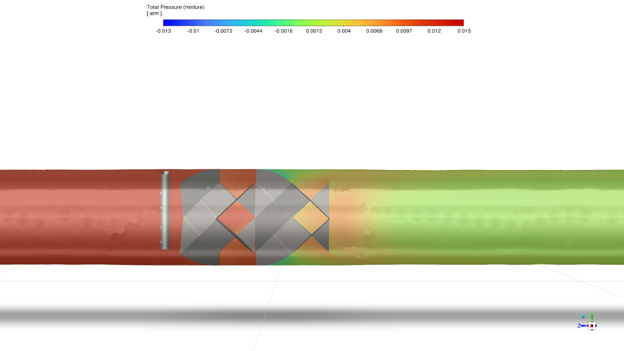
A static mixer takes the energy it needs from the stream passing through it, without requiring an additional power input. This makes static mixing extremely energy efficient In a pumped line, that energy loss appears as a static mixer pressure drop; in an open channel, the equivalent design concern is headloss. Static mixer pressure loss inevitably occurs as mixer elements interrupt and redirect the flow, increasing contact between the components being blended, dosed or conditioned.

To avoid this, the hydraulic cost of that work has to be known before the mixer is installed, because the available pressure margin may already be allocated to pipe length, valves, strainers, heat exchangers, control devices and downstream process equipment. Read on as we explore the issue of static mixer pressure drop and what it means for your process efficiency.
Pressure Drop Belongs To The Whole System
Static mixer pressure drop is not a static calculation, but changes with flowrate, pipe diameter, density, viscosity, element geometry and the number of mixing elements in your asset. For instance, a low-viscosity turbulent dosing duty will create a different hydraulic condition from a viscous product stream, even when both applications use the same basic mixing principle. The full operating range also needs to be considered, because a mixer selected around peak flow may behave differently when the plant runs at reduced throughput.
That is why pressure loss should be treated as part of the system curve. If the mixer consumes more pressure than the line can spare, flow capacity may be reduced or additional pumping energy may be needed. If pressure loss is minimised without defining mixture quality, the process may still leave the mixer with poor distribution at the point where the blend, dose or sample needs to be representative.
Mixture Quality Needs A Separate Target
Pressure drop represents the hydraulic cost of mixing, but is not the measurement of mixture quality. For many turbulent applications, mixture quality is defined by coefficient of variation, or CoV, at the mixer discharge or at a stated downstream location. A CoV of 0.05 is generally treated as complete homogeneity for many turbulent duties, but the correct value and location depend on the process. Pressure drop describes the hydraulic demand; CoV describes the mixing result.
How Poor Mixing Can Create Hidden Inefficiency
The process cost of poor mixing often appears downstream. In a dosing application, for example, uneven distribution can delay chemical reactions, distort analyser readings or force operators to increase dose to compensate for incomplete contact. In a blending application, the problem may appear as product variation, longer residence time, additional recirculation or unstable control.
This is why pressure drop and process efficiency need to be considered together. A mixer that reaches the required CoV quickly may reduce the distance between injection, mixing and sampling. That can improve control response and reduce the need for excessive downstream pipe length. But if the same result can be achieved with lower pressure loss or shorter mixing length, the process gains efficiency without weakening mixture quality.
Pump Capacity Sets The Boundary
The available pressure margin in the line is not unlimited. Pumps, valves, strainers, heat exchangers, instruments and downstream equipment all consume part of the hydraulic allowance. If the static mixer pressure drop is too high for your existing system, the flow capacity may fall or pump energy may increase. If the pressure drop is cut too far without protecting mixture quality, the process may appear hydraulically efficient while failing at the point of use.
The most efficient static mixer is therefore the design that achieves the required mixture quality at the required point with an acceptable pressure loss and installed length; striking a balance between energy use, flow capacity, control response and process outcome.
Discuss Your Static Mixer Requirements
To find out more, speak to one of our experts about your process conditions, including flow rates, fluid properties, mixture quality targets and allowable pressure loss. We will assess your requirements and recommend a static mixer solution tailored to your duty, taking into account performance, installation constraints and long-term operational reliability.

